Practising the Special Manoeuvres on Your Driving Test
· 6 min read · Thomas Wolten
Reversing, parking and changing lanes: the manoeuvres that test your precision. What the examiner assesses and an approach that works.
In this article
- What are the special manoeuvres?
- What to expect
- What is assessed
- An approach that works
- When it goes wrong
- Observation remains the most important thing
- Common mistakes
- Frequently asked questions
- Why precision matters more than speed
- The role of your seating position and mirrors
- Practising with a fixed sequence
Besides driving in traffic, the practical driving test includes a series of technical manoeuvres. They test your precision, your control of the vehicle and your observation, separate from the rest of the traffic. Many candidates underestimate this part. Yet it is one of the most predictable parts of the test, and therefore also one of the easiest to train for.
What are the special manoeuvres?
These are manoeuvres in which you have to steer the vehicle accurately in a confined space, often with limited visibility or in reverse. They simulate everyday traffic situations: parking in a busy street, reversing into a dead-end alley or changing lanes safely on a road with several lanes. Unlike the free driving section, you know in advance that this part is coming. That makes it an excellent opportunity to secure points.
What to expect
The examiner picks a number of tasks from a fixed list. Exactly which ones, and in what form, can vary, so also check the information from your driving school or exam centre. The most common ones are the following.
Reversing in a straight line. You reverse straight back over a certain distance, checking your mirrors and glancing over your shoulder regularly. The challenge lies in keeping the line straight: noticing small deviations in time and correcting them before they become big.
Reversing around a bend. You follow a curve in reverse, for example the edge of the kerb or a marked line. This takes more feel for the steering, because you constantly have to judge how far the back of the car stays from the edge while looking backwards.
Perpendicular parking. You park the car at a right angle between two boundaries, usually reversing in. This tests your judgement of distance on both sides and the right moment to turn the wheel.
Parallel parking. You park between two vehicles or markings in the direction of the street. Timing is crucial: steer in too early and you hit the car in front, too late and you end up too far from the kerb.
Changing lanes. This manoeuvre tests your steering technique less and your observation and decision-making more: mirrors, shoulder check, signalling in good time and only changing when it is safe.
What is assessed
Besides performing the manoeuvre correctly, the examiner looks at your observation: do you check your mirrors and look over your shoulder enough, and do you take other road users into account? Smoothness also counts. Jerky steering or repeatedly correcting forwards and backwards is rated less favourably than a calm, controlled execution, even if it takes a little longer.
An approach that works
The special manoeuvres are easy to practise in a quiet, empty car park. There you can work on precision without pressure and without traffic.
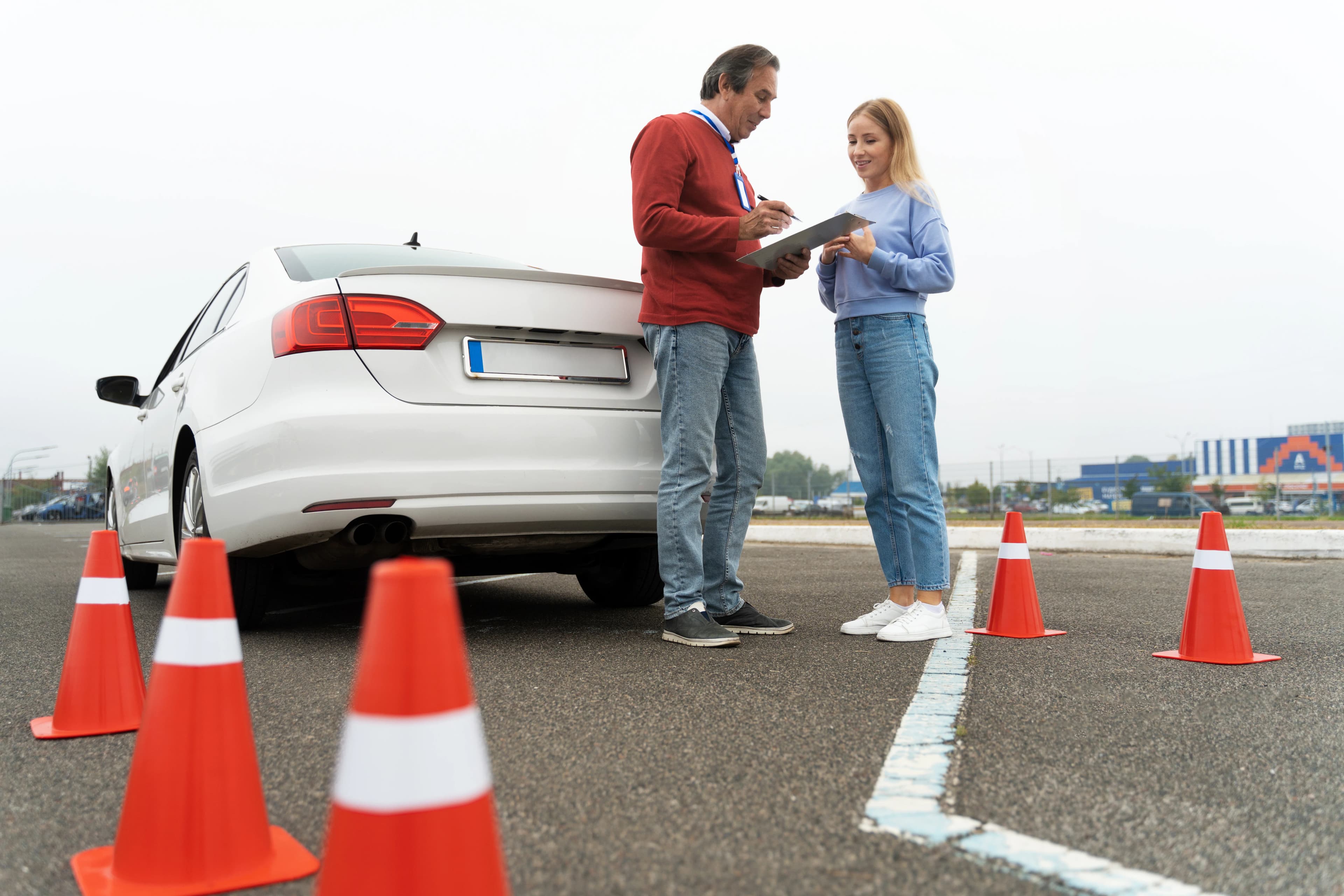
First get to know your vehicle. You need to know where the extremities of your car are. Practise with cones, empty crates or cardboard boxes to get a feel for the distance behind and beside your car. Ask your supervisor to stand next to you and tell you how much space is left. That way you learn to judge distances without guessing.
Then do it slowly. Speed is the enemy of precision. Drive so slowly that the car is barely rolling at walking pace, with your foot lightly on the brake. At low speed you have more time to look and adjust.
Look for fixed reference points: a certain part of your mirror, a line on the ground, a spot on your bonnet. When that point lines up with a line or edge, you know it is time to turn the wheel. Every car and every driver finds their own references, so experiment and note down what works for you.
Only when it goes smoothly do you practise under light pressure: a limited number of attempts, no tips and an assessment afterwards, just like the test.
When it goes wrong
A manoeuvre can go wrong: you end up at too much of an angle, you nearly hit something or you lose your feel for it. Don't panic. Stop, look around calmly and work out what you need to correct. If necessary, drive forward a little to start again. A calm correction says more about your driving ability than a manoeuvre that works out by chance.
Observation remains the most important thing
It is tempting to focus only on the steering during a manoeuvre, but the traffic around you doesn't disappear. Keep checking whether pedestrians, cyclists or cars are approaching, even if the car is almost stationary. A manoeuvre that is technically perfect but in which you miss an approaching cyclist is marked down heavily.
Common mistakes
Observing too little is the classic: once they have started, candidates forget to keep checking because they are focused on the steering. Doing it too fast is also common, under time pressure, even though speed comes at the expense of precision. And some give up too early at the slightest deviation. A small correction is not a problem, and is usually the best solution.
Frequently asked questions
Can I stop during a manoeuvre to look around? Yes. Stopping calmly and observing is better than carrying on without visibility.
What if I don't understand the task? Ask the examiner to repeat it. That is not a weakness, but carefulness.
Why precision matters more than speed
A manoeuvre that is completed quickly but sloppily generally scores worse than one that takes a little longer but is controlled. The reason is simple: an examiner doesn't assess how fast you finish, but whether you are fully in control of the vehicle. Every extra second you take to look, correct and adjust calmly works in your favour.
The role of your seating position and mirrors
When reversing and parking, a lot depends on how you sit and how your mirrors are set. If you sit too far from the wheel or too low, you see less. Adjust your seat and mirrors before you start and make sure you have a good view of the rear and sides of the car. Turn your body when reversing so you can look over your shoulder without straining. If you sit comfortably, you steer more smoothly and observe better.
Practising with a fixed sequence
A fixed sequence prevents you from forgetting things when you are stressed. For every manoeuvre you can go through the same steps: first observe, then determine your position, then start slowly, keep checking during the manoeuvre and finally finish and park your car neatly. Practise that sequence so often that it becomes automatic. Then on test day you no longer need to think about what the next step is, and you can focus entirely on precision and observation.
How often should I practise? That differs from person to person. A good sign is that you can carry out the manoeuvres calmly and without tips, even when someone is watching.