Roundabouts on the Driving Test: Approach to Exit
· 5 min read · Thomas Wolten
Almost every test route includes at least one roundabout. What examiners expect, where candidates make mistakes and how to drive through calmly.
In this article
Some candidates drive through a test almost without a worry, until they approach a roundabout. Suddenly they have to judge priority, choose a lane, signal their direction and watch for cyclists, all within a few seconds. Yet the roundabout is one of the most predictable parts of the test. If you have the sequence down, you drive through it relaxed.
Who has priority?
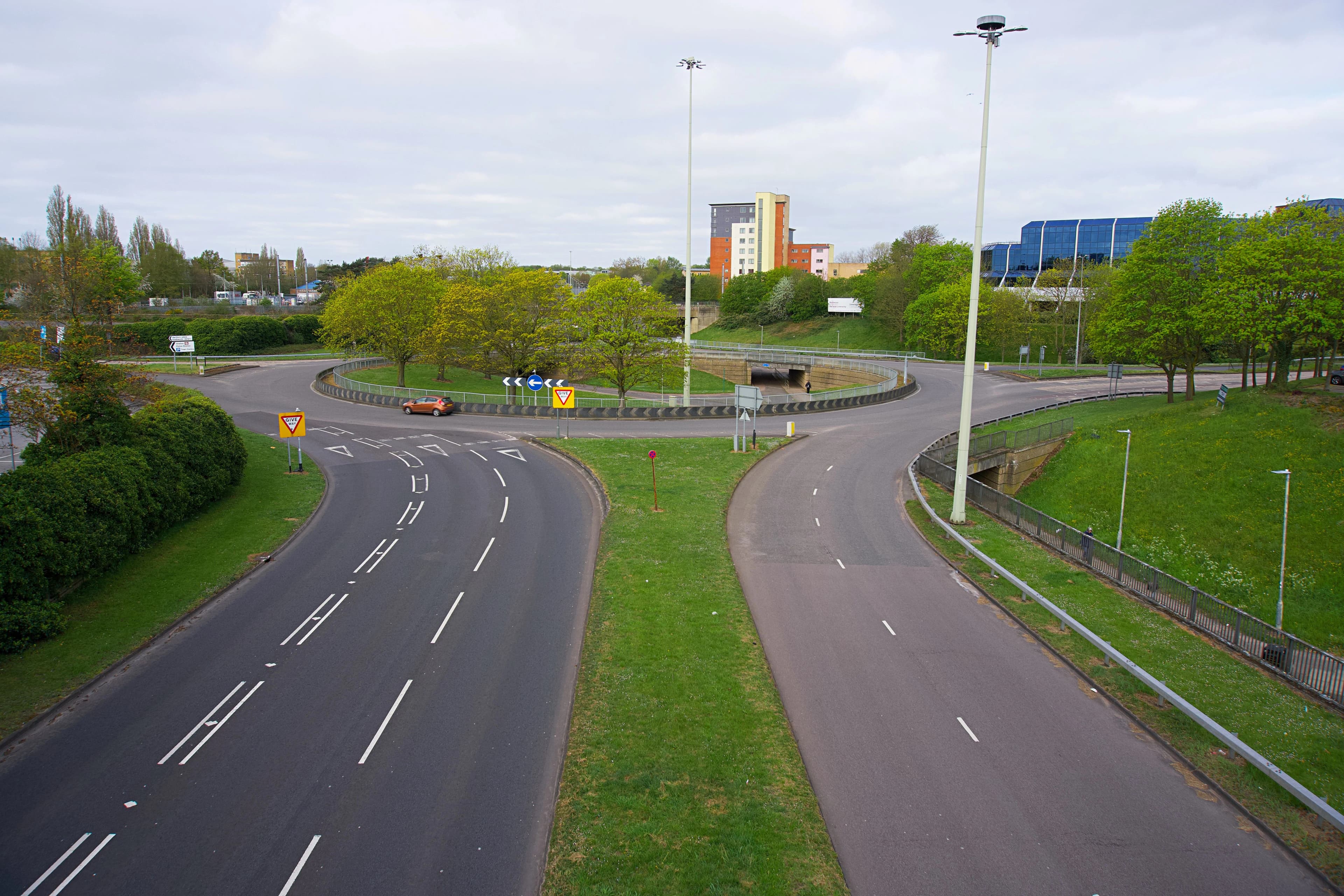
Usually there is a sign before the roundabout requiring you to give way to traffic already on the roundabout. So you let the traffic on the roundabout pass first. If that sign is missing, the normal rule applies: priority to the right. Always check, because not every roundabout is laid out the same way.
The four-step approach
Approach. You see the roundabout well in advance and reduce your speed. You don't need to stop if there is nobody there, but you must be able to stop if necessary. If there are several lanes, choose the right one already while approaching.
Observe. Look to the left, because that is where the traffic on the roundabout comes from. Also watch for cyclists, for pedestrians at a zebra crossing just before the roundabout and for the car in front of you, which may brake unexpectedly.
Enter. Drive in when there is a safe gap. Don't wait longer than necessary, but don't force anything either. A calm, predictable entry counts for more than a fast one.
Exit. Signal in good time and, as you leave, take one more careful look for cyclists and pedestrians at the exit. It is precisely at that moment that things regularly go wrong, because candidates are already thinking about the next situation.
Different roundabouts, different challenges
A small roundabout leaves little margin: you drive over it almost straight, and other road users come close quickly. A calm speed is especially important there. A large roundabout with several lanes mainly requires you to choose the right lane in good time. The markings and arrows on the road surface and the signs before the roundabout tell you what to do, but only if you read them in time.
Many roundabouts have a cycle path around them. Depending on the layout, cyclists may have priority at the entrances and exits. So pay close attention to signs and markings, and look both left and right when exiting.
The indicator
Candidates have many variants in their heads about the exact sequence of indicators when entering and exiting. The main principle remains simple: let others know in good time what you are going to do. Especially when leaving the roundabout, a clear signal is important, because following drivers and cyclists need to be able to tell whether you are staying on the roundabout or turning off. If you want to be sure what the current recommendation is, ask your driving school or check the official highway code. On the test the examiner mainly wants to see consistent and timely signalling.
Common mistakes
Approaching too fast is the most common, so that you can no longer stop when someone is on the roundabout. The opposite is just as annoying: waiting too long, which holds up the traffic behind you and makes you nervous yourself. You also see candidates who take the wrong lane because they saw the sign too late, who cut the bend instead of following their lane, or who forget to look for cyclists when exiting.
What if you miss your exit?
This is the biggest fear, and at the same time the least dramatic situation. Calmly drive an extra lap or take the next possible exit. An extra lap is much better than steering or braking abruptly, and it shows that you make a safe decision instead of taking a risk. If necessary, tell the examiner: they can quickly give you new directions.
A practice plan that works
Find at least three different roundabouts in your area: a small one, a large one and one with several lanes. Drive each of them several times, always keeping the same sequence in mind: speed, observe, enter, exit. On each lap take a different exit: first, second, third. On a final lap, have your supervisor suddenly point to a different exit, so that you have to switch. Finally, drive the same roundabout once at rush hour and once when it is quiet: you will notice how your approach changes.
A mental anchor
Many candidates find it helpful to sum up the approach in three words: look, choose, stay calm. It is a fixed sequence that prevents you from losing focus in the bustle of a large roundabout. If you have a pattern, you don't need to improvise.
Buses, lorries and wide vehicles
On a roundabout, large vehicles take up more space. A bus or lorry sometimes has to swing out to take a bend, and may use part of the adjacent lane. So don't drive alongside such a vehicle on a roundabout with several lanes, and give extra space when you see one ahead of you. Before you know it, you are in its blind spot.
Also when following a long vehicle, it pays to keep a greater distance. You see more of the roundabout, and you have more time to react if the vehicle slows down or swerves.
Roundabouts at rush hour
At busy times a roundabout becomes a matter of timing. The traffic on the roundabout gets denser and the gaps are shorter. So don't just look at the nearest car, but at the rhythm of the traffic: where is there a gap, how fast is it coming towards you and is someone unexpectedly leaving? If you stay calm and take your chance when it comes, you drive more safely than someone who forces a gap that is too small out of impatience.
When a roundabout is shared with a bus or tram
On some roundabouts buses or trams run, with their own priority rules or a separate lane. Pay attention to signs and markings, and be extra careful when a bus is driving in front of you, because it can stop abruptly or swing out. Keep more distance than usual and be prepared for an unexpected movement.
Roundabouts will keep coming back throughout your driving life, and each one is different. The approach you learn now, namely slowing down in good time, looking carefully, entering calmly and exiting safely, will always remain useful. The test is then not an end point, but the moment you show that you have mastered the basics.