Zone 30 and School Areas: Choosing the Right Speed
· 5 min read · Thomas Wolten
A speed sign gives a maximum, not an instruction. How to choose the right speed every time on the practical driving test, even when you are within the limit.
In this article
On a test you can drive entirely within the permitted speed and still lose points. That surprises many candidates. After all, a speed sign indicates the maximum, not what you should be driving at that moment. What an examiner wants to see is that you adapt your speed every time to what the situation allows.
The sign is a ceiling
A sign with a maximum speed tells you what you are allowed to do, not what is sensible. In a narrow street with parked cars, where children can appear between the vehicles, driving slower than the limit is not excessive caution, just logical. You decide each time on the basis of visibility and weather, how busy it is, the presence of cyclists and pedestrians, the state of the road and your view at junctions and driveways.
What counts per zone
Built-up area. Inside a built-up area a general maximum speed applies, unless signs indicate otherwise. Watch for the signs at the start and end and adjust your speed immediately. In some cities the permitted speed is also lower almost everywhere, so don't simply assume what you are used to.
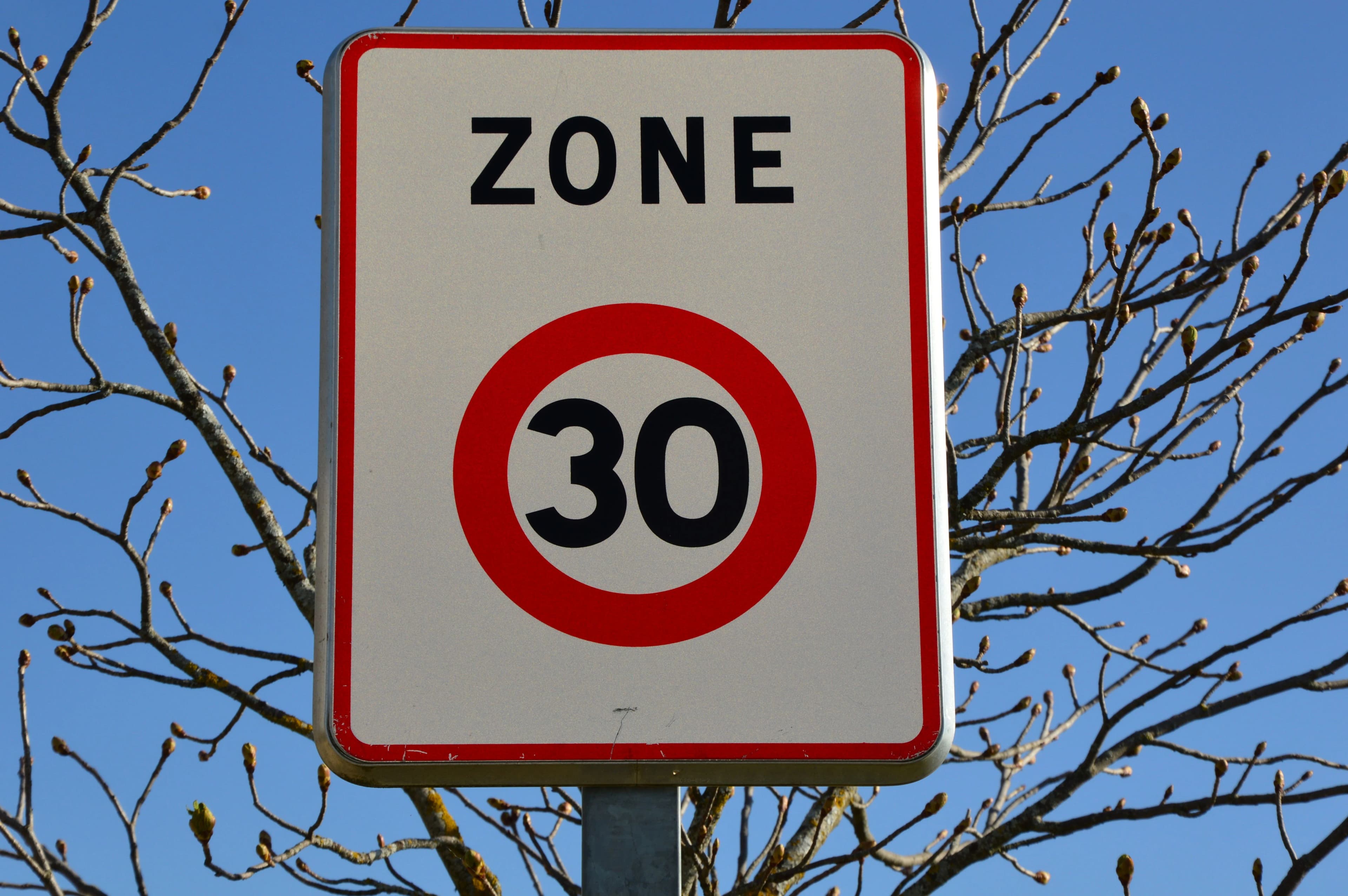
Zone 30. A zone 30 begins and ends with a sign and applies to all streets within the zone. It is often a residential area or the surroundings of a school. Keep your speed really under control here: at priority-to-the-right junctions, driveways and crossings you must be able to stop.
School area. Near schools a lower speed often applies at certain hours. Read the sign, including the supplementary plate with the hours, and look at what is happening around the school. Children can cross unexpectedly, and an examiner pays extra attention to how you drive there, especially at busy times.
Cycle street. In a cycle street the maximum speed is low and cars are not allowed to overtake cyclists. So drive patiently behind a cyclist.
Too slow is also a mistake
Out of fear of driving too fast, some candidates drive far too slowly. That seems safe, but it holds up the traffic behind you and can provoke dangerous situations because others want to overtake you or drive close behind you. Aim to move smoothly with the traffic, within the limit and within what is safe. If you may go faster and it is safe, you are also allowed to do so.
Anticipating: adjusting your speed in advance
The difference between a calm and a jerky drive rarely lies in the brakes, but in anticipation. If you see a junction, roundabout or zebra crossing coming, take your foot off the accelerator early. A late, hard brake is almost always the result of looking too late. A smooth drive with timely speed adjustments gives the impression that you have the situation under control, and that is exactly what an examiner wants to see.
Your speedometer and your feel
If you look at your speedometer too long, you are not looking at the road. A short glance is enough. It is more important to develop a feel for speed: how does fifty kilometres per hour feel in a residential area, and how does thirty feel? You learn that by occasionally estimating before you look at the speedometer, paying attention to the surroundings, the engine noise and how fast buildings and trees go by.
Speed and predictability
A driver who adjusts their speed smoothly is easier for others to predict. Sudden changes in speed create unexpected situations, so drive evenly: take your foot off the accelerator in good time, brake gently and let the car coast where you can.
The speed drive as practice
Agree with your supervisor that for one whole drive you will only focus on your speed. At each sign or zone you say aloud what speed you are going to drive and why. Your supervisor notes when you drove too fast or too slow. Afterwards you discuss why that happened. Often the cause turns out not to be ignorance but habit or distraction, and that insight helps you adjust in a targeted way.
On test day
Nerves often make your speed creep up or drop. Check your speedometer now and then, but mainly keep your eyes on the road. If you notice you are going too fast, correct calmly. A small, quick correction is rated better than a speed that gets out of hand.
An example drive through a municipality
Imagine a drive that begins on a wide approach road on the edge of a municipality. Here you may go faster, but you notice a sign announcing that the built-up area begins. You take your foot off the accelerator and bring your speed down before you have even passed the sign. A little further on you turn into a residential area laid out as a zone 30. You drive calmly, watch for driveways and keep your foot near the brake, because a child could come out from behind a parked car.
Then you arrive in the centre, where cyclists and pedestrians dominate the street scene. You drive slower than the limit allows, because the situation calls for it. And at the end of the drive you pass a school, just as the pupils are coming out. Your speed is lower again, your eyes are constantly moving and you are prepared for the unexpected.
The nice thing about such a drive is that each time you adjust your speed to what you see and not to a number. That is exactly what an examiner assesses.
Dynamic and temporary speed signs
Some zones show their speed on an electronic sign that changes according to the time of day or traffic levels. Read the sign every time, because the limit may be different from last time. The same goes for temporary signs at roadworks: they apply for the duration of the works and override the permanent signage. So don't rely on your memory of the road, but on what you see at that moment.
If you control your speed well, you also feel more confident. You need to rush less, you have more time to look and you make fewer mistakes under pressure. So adjust your speed not only when a sign asks for it, but also when the situation asks for it: a child at the side of the road, a ball rolling into the street or a cyclist wobbling uncertainly are signals to slow down, before anything happens.