Recognise Road Signs Faster Before Your Driving Test
· 6 min read · Thomas Wolten
If you only notice signs late, you're always one step behind. Here's how to train your eyes, which signs cause confusion and how to practise at home.
In this article
- Why reading speed matters
- Look further ahead
- Group signs by category
- Signs that often cause confusion
- Practise with repetition and variety
- Combine the sign with the situation
- The situations that come up most often
- A practice drive focused on signs
- Why signs still get missed sometimes
- Road markings are part of it
- What to do if you don't understand a sign
In an exam, road signs are rarely the problem. The problem is that they get noticed at the wrong moment: too late, half read or misunderstood. If you only spot a sign once you've already passed it, you're always reacting after the fact. If you read it from far ahead, you can adapt your driving to what's coming.
Why reading speed matters
While driving, you're constantly processing information: the road, other road users, your own speed. Road signs come on top of that. The more smoothly you recognise them, the more attention you have left for everything else. For new drivers, a large share of their attention goes into deciphering signs, leaving less for cyclists and pedestrians. So if you recognise signs automatically, you don't just drive more correctly, you drive more safely too.
Look further ahead
Most candidates look too close to the front of their car. Their eyes rest on the first twenty metres of the road, while the information is much further away. Train yourself to deliberately look far ahead, to the point where the road narrows. That way you see signs and road markings in time, before you even need them. It helps to pick an imaginary point in the distance on every street and look at it more often than at the road surface right in front of you.
Group signs by category
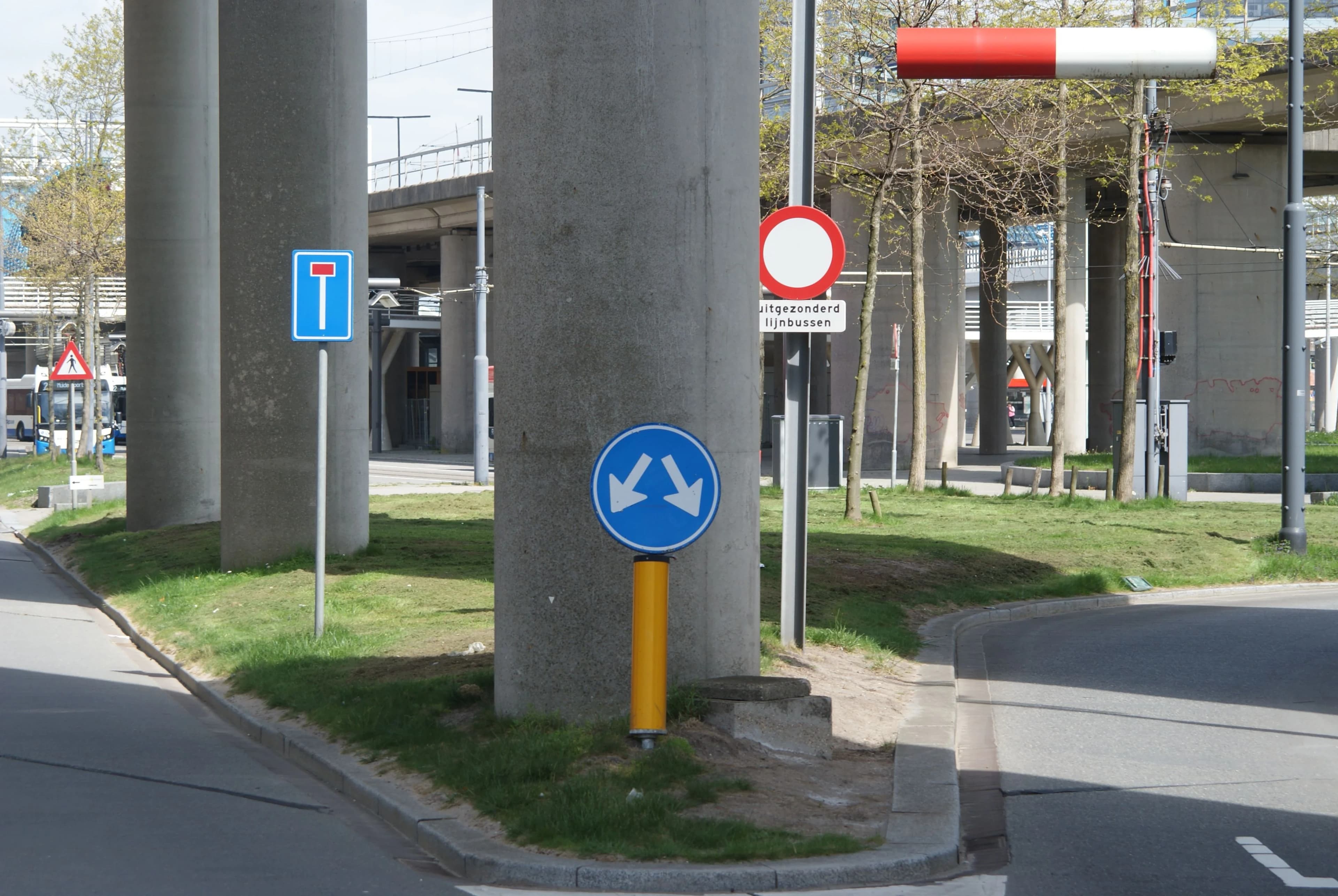
Your memory stores information better when it's organised. So don't learn signs as one long list, but by category. Warning signs alert you to something ahead. Priority signs determine who has right of way. Prohibitory and mandatory signs impose an obligation or a restriction. Information signs provide information. By placing every new sign in a group, you can often already work out the meaning of a sign you've never seen before: shape and colour tell you a lot.
Signs that often cause confusion
Priority signs. The "give way" sign and the stop sign are similar in function but call for a completely different reaction. At a stop sign you must come to a complete halt, even if nobody is around. At a "give way" sign you may carry on without stopping, as long as the road is clear. If you mix up the two, you make a mistake the examiner notices immediately.
Supplementary plates. Underneath a sign there is sometimes a smaller one that limits or extends the rule, for example to certain hours, days or vehicles. A speed limit at a school usually doesn't apply all day. So always read the supplementary plate too, and don't assume the rule applies at all times.
The end of a zone. Many candidates see the start of a zone but forget that there's a sign that ends it. As a result, they drive slower for too long, or think a restriction still applies when they're already allowed to speed up again.
Temporary signage. At roadworks, temporary signs are put up that differ from the permanent signage. These temporary signs take precedence over the permanent ones. Follow them, even if you'd normally drive the road differently.
Practise with repetition and variety
You can't memorise signs by reading them once. Repetition in short sessions works better than long study sessions. Here are a few methods you can use at home:
Make your own flashcards with a sign on the front and, on the back, its meaning and the action that goes with it. Spend five minutes a day on them, preferably at varying times. Name signs out loud while out walking or cycling: it feels strange, but your memory retains what you actively use better. Ask your supervisor to quiz you every now and then on what a sign means and what you do about it. And test yourself on combinations, such as a sign with a supplementary plate or a sign combined with a road marking, because they're harder than a sign on its own.
Combine the sign with the situation
A sign rarely gives you the full picture. It only becomes meaningful in combination with what you see around you. A sign announcing a 30 zone takes on extra meaning when you see children on the pavement. A priority sign has to be linked to your view of the junction. So don't just learn what a sign means, but also what you actually do about it: slow down, choose your position, look more carefully, give way.
The situations that come up most often
During an exam, a large share of the signs revolve around a limited number of situations: priority at junctions, speed limits, direction signs at roundabouts and junctions, parking and stopping bans, and signs concerning vulnerable road users such as zebra crossings and cycle crossings. If you master those categories, you cover most of what's needed.
A practice drive focused on signs
Plan a drive with a single goal: noticing signs. Drive a route you know and agree with your supervisor that you name every sign you see and briefly say what it means. Have your supervisor note which signs you miss or misread. Then drive the same route in the opposite direction. It's striking how often signs you didn't see the first time stand out straight away the second time, precisely because you now expect them.
Why signs still get missed sometimes
Even experienced drivers occasionally miss a sign. The reason is rarely ignorance. Usually it's distraction, time pressure or a sign that's hard to see: hidden by a tree, behind a parked lorry or just past a bend. Candidates who know this look more actively. They look for signs not only to the right of the road, but also to the left, above the road and on the road surface.
Road markings are part of it
Signs give only part of the information. Road markings supplement or replace them. Solid and broken lines determine where you may overtake and where you must stay put. Triangles on the road surface indicate that you must give way. Arrows show which direction you may go. If you learn signs but ignore markings, you're only reading half of the street. Make it a habit to always read signs and markings together.
What to do if you don't understand a sign
Sometimes you see a sign that you don't know or aren't sure about. Stay calm, slow down and act as you would if you were unsure: carefully and predictably. Note the sign afterwards and look up its meaning in the official highway code. In the exam, a cautious reaction to uncertainty is always better than a guess.
Do this exercise a few times on different routes and you'll notice your field of view widening. You read further ahead, you recognise patterns and you drive more calmly. That's ultimately the goal: not to know every sign by heart, but to see them in time and know what to do about them.