Priority to the Right in Your Practical Driving Test
· 5 min read · Thomas Wolten
On paper, priority to the right is simple. In practice it often goes wrong with the exceptions and with how you look. A thorough explanation for your test.
In this article
Ask any candidate what priority to the right is and they'll recite the rule flawlessly. Put the same candidate in a residential area with four similar junctions in a row, and suddenly it becomes less certain. Not because the rule is so complicated, but because it rarely comes alone. There are exceptions, visibility that disappoints and other road users who don't always stick to the rule.
The rule itself
At a junction where nothing else is indicated, you give way to anyone coming from the right. That applies to everyone: cars, cyclists, moped riders and other vehicles. What the rule doesn't say is that you have to stop at every junction. You slow down so that you can stop, you look, and you decide: wait or drive on.
That last point is more important than it sounds. Examiners don't only assess whether you respect priority, but also how you arrive at your decision. If you approach a junction without slowing down because you "don't have to give way anyway", yet fail to see someone coming from the right, you're in for a rough time.
When the rule doesn't apply
Priority to the right is a fallback rule. It only applies when nothing else determines priority. In practice, it lapses in situations such as these:
Traffic signs always come first. A priority sign, a stop sign or the sign that obliges you to give way sets the ordinary rule aside. The same goes for traffic lights and for instructions from a traffic officer. If you come out of a driveway, exit or car park onto the public road, you don't have priority, even if traffic comes from the left. And where trams or trains run, their own rules apply.
A simple habit helps you avoid guessing: at every junction, first look for lights, then for signs and road markings, and only if you find nothing do you apply priority to the right. That order takes you a second and removes a lot of doubt.
Where it goes wrong in practice
Looking too late. Many candidates only look right when they're almost at the junction. By then it's too late to decide calmly. Looking starts well before the junction, when you see it coming and your foot is already coming off the accelerator.
Hesitating for no reason. The opposite is just as common. If you have priority and still stay put, you confuse traffic and give an impression of uncertainty. If you hesitate because you're not sure, that's a sign you should have slowed down earlier and looked better.
Counting on the other person. The rule says who has priority, not who actually takes it. A driver from the right who doesn't slow down enough is someone you need to be able to spot. So if you have priority, keep looking and keep your foot near the brake.
Overlooking cyclists. Electric bikes in particular arrive faster than you think. A cyclist on a cycle path crossing the junction is easily missed because you're only looking at cars.
Examples from everyday traffic
Picture a residential area with a series of identical side streets. Priority to the right applies at each of those junctions. The challenge isn't the rule, but the repetition: you have to look again at every junction, even when the last three were quiet.
Another example is the junction just after a bend. Because of the bend, visibility is limited, so you have little time to assess what's coming from the right. If you already slow down in the bend, you keep a margin.
On a priority road, it's tempting to ignore side streets. Still, it remains wise to scan. Drivers turning onto the road from a side street sometimes overestimate their chances, and you're the one who has to brake.
Approaching a junction without rushing
The sequence that works well in the test is simple. You see the junction early, you take your foot off the accelerator, you slow to a speed at which you can stop, you look right, left and right again, and you decide. Only then do you drive on, smoothly and without haste.
It sounds like a lot for something that takes a few seconds, but with a well-practised routine it feels like a single movement.
How to practise
Choose a neighbourhood with many equivalent junctions and drive around calmly. Say out loud what you see: "priority to the right, clear, I'm going". Ask your supervisor to check whether you're already looking before you reach the junction and whether you adjust your speed in time. Afterwards, also look for junctions where signs determine priority, so that you learn to see the difference automatically.
Road markings that determine priority
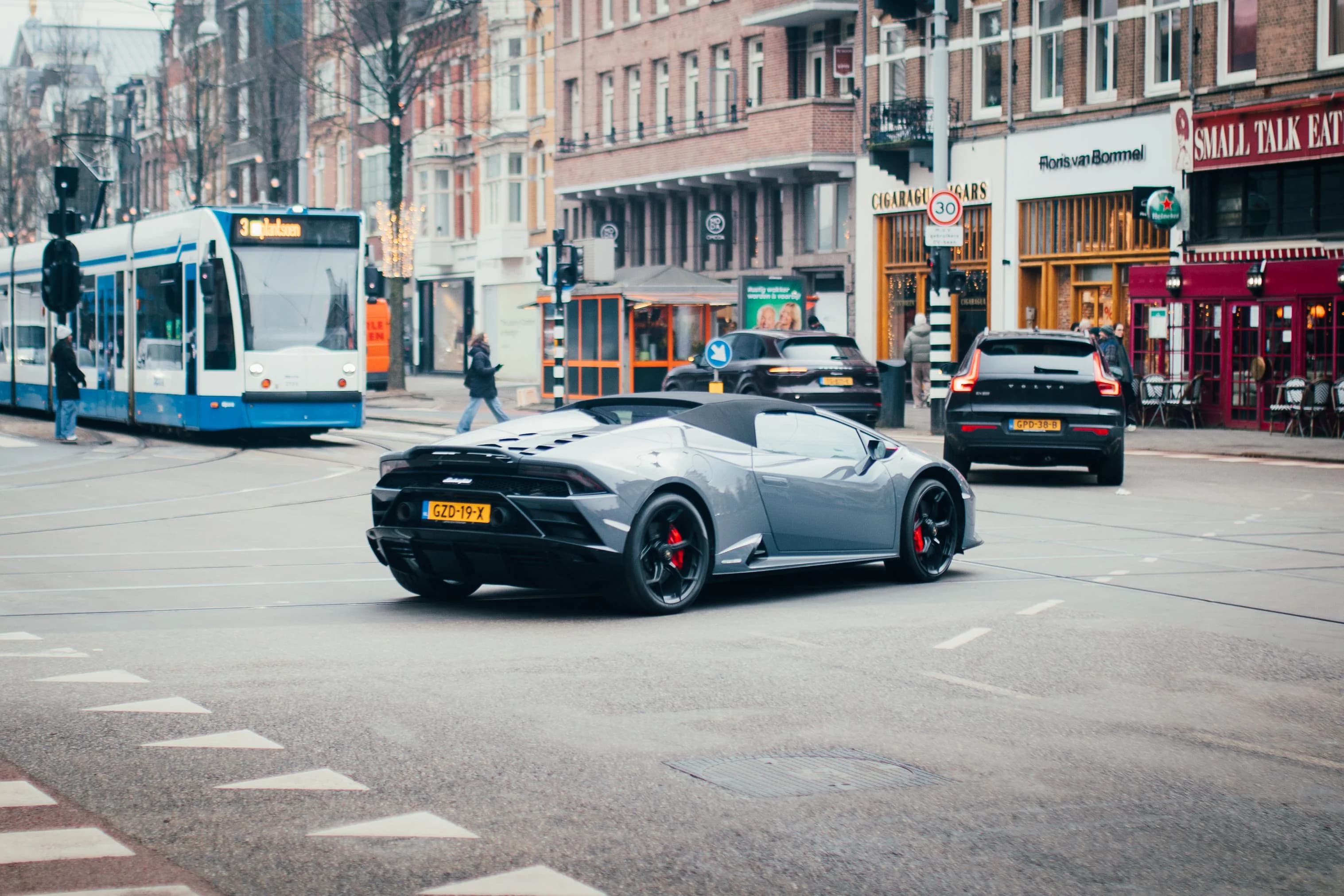
It isn't only signs that regulate priority. Road markings do too. A row of white triangles, popularly known as "shark's teeth", on the road surface before a junction means you must give way to traffic on the other road. They're often combined with a sign, but they can also stand alone. If you only look at signs and ignore markings, you miss information. So develop the habit: signs, markings and lights all belong together in the "reading" of a junction.
Junctions that mislead you
Some junctions look equivalent at first glance, but aren't. A side street may be clearly narrower or be marked out by a different road surface. That doesn't automatically change the rule, but it's a clue that the layout means something. Also look at the sign post: sometimes the priority sign is just behind a corner or hidden by a hedge. Slowing down when you're in doubt gives you time to see it after all.
On a square or in a street with many driveways, it's good not only to look to the right, but also to take into account drivers coming out of a driveway. They must give way to you, but don't always expect you to be there.
Priority to the right doesn't have to be something to fear. If you look early, slow down calmly and know when the rule doesn't apply, you'll rarely have a problem with it. If you ever doubt a specific situation, consult your driving school or the official highway code: rules can be changed, and it pays to know the current version.