Amber Light in the Driving Test: Stop or Go?
· 6 min read · Thomas Wolten
The amber phase makes many candidates hesitate. What the rule says, how to decide in time and why accelerating is never the answer.
In this article
- What amber really means
- The decision is made before the light changes
- Stop or carry on
- Red and green
- Different junctions, different rules
- Following distance matters too
- Look beyond your own light
- Common mistakes
- How to practise
- Two scenarios to remember
- What to do at a junction with traffic lights and limited visibility
- A light that gets stuck
Red means stop, green means go. It's with amber that the debate begins. In the practical driving test you see it regularly: a candidate approaches a junction, sees the light change and has to make a choice in a fraction of a second. One slams on the brakes, another steps on the gas. Both reactions are usually wrong.
What amber really means
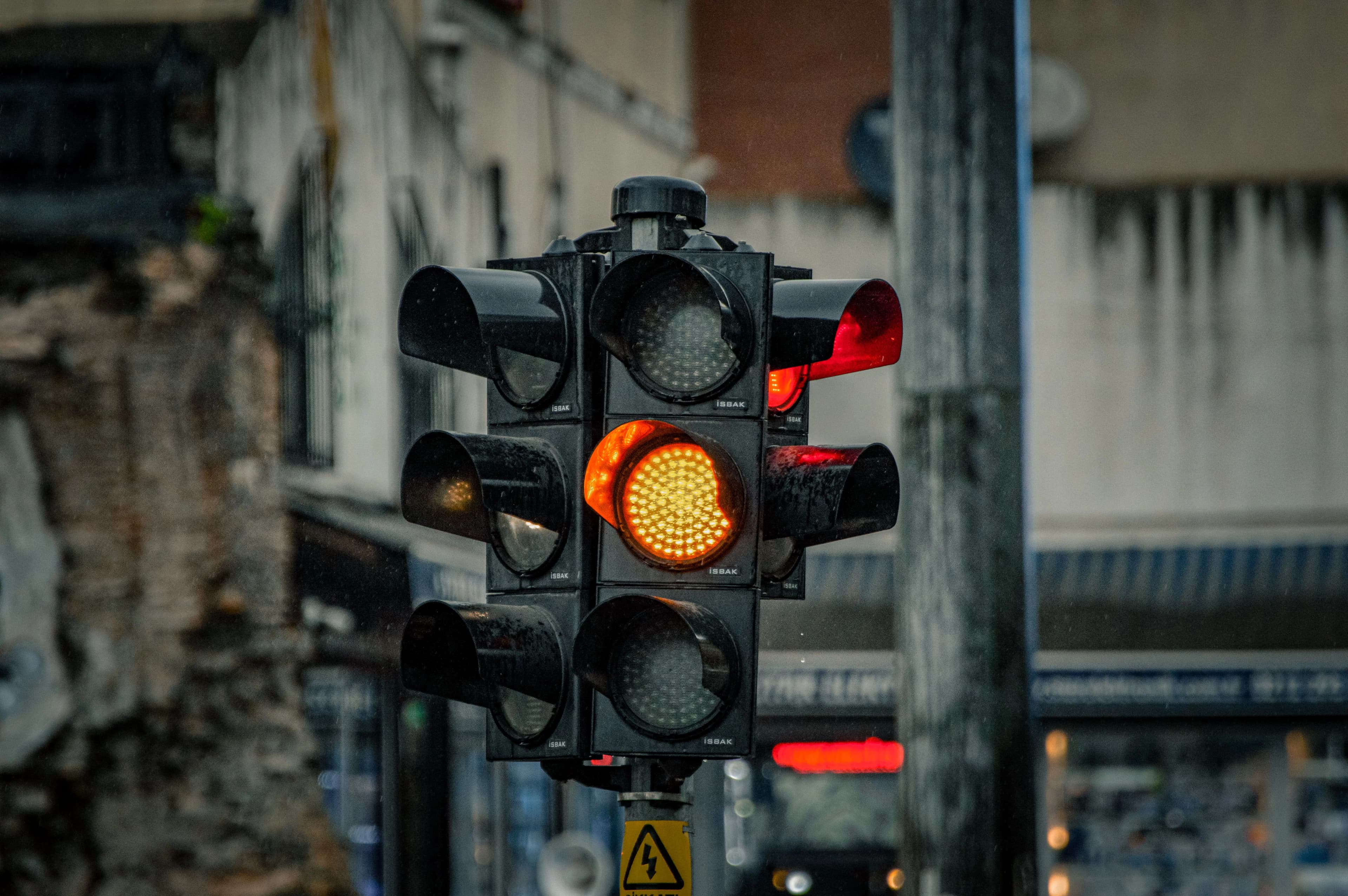
Amber means you must stop, unless you can no longer stop safely. So it is not a warning to quickly get through. The decision depends on your speed, your distance to the stop line and what's happening behind you.
The decision is made before the light changes
If you only start thinking at amber, you're already too late. The right decision starts well before the junction, with what you notice. Has the light been green for a long time? Then it can change quickly. Have pedestrians been waiting at their crossing for a while? Then the next phase is on its way. And is the car in front of you already braking? Then you need to be ready too.
So when approaching a light that has been green for a long time, take your foot off the accelerator in good time, so you can react when it changes. It's not about braking on a hunch, but about keeping your options open.
Stop or carry on
If you can stop safely before the line without braking hard, you stop. If you're so close to the line that you could only stop with an emergency stop that would be dangerous for the driver behind, you carry on, without speeding up. That last point is essential: accelerating to beat the light is never the right choice. In a test, both needlessly sharp stops and forced driving through are marked down.
Red and green
At red, you stop before the stop line, or before the light itself if there's no line. If you stop too early, you don't hinder anyone, but if you stop too far past the line, you may block a crossing. So stop calmly and precisely. If you're first in line, stay alert when the light turns green and take another look left and right, because sometimes someone is still driving through red.
Green is not a free pass. Check that the junction is clear, give way to pedestrians who are still crossing and, when turning left, let oncoming traffic go first unless a separate light gives you priority.
Different junctions, different rules
At wide junctions with many lanes, it's important to read the light for your own lane and not the one for the lane next to you. Some junctions have a separate phase for turning left: wait until your light is green, even if the cars next to you are already setting off. Cyclists and pedestrians sometimes have their own light or a head start. A cyclist with green has priority over you, even if your light is green too.
If the lights aren't working or are flashing amber, the normal rules apply again: look for priority signs or apply priority to the right, and be extra careful.
Following distance matters too
Many accidents at traffic lights happen because the driver behind can't stop in time. A safe following distance and early, gentle braking give them time to react. Also check your mirror regularly when you know you have to stop.
Something else you never do is enter a junction without being sure you can get across to the other side. If you get stuck in the middle of a junction because traffic comes to a standstill, you block the cross traffic. It's better to wait before the junction, even at green, until there's room.
Look beyond your own light
Many candidates only look at the light in front of them. If you also pay attention to the cross traffic's lights, the pedestrian lights and the behaviour of other drivers, you get a better picture of which phase the junction is in. That makes the decision at amber almost obvious.
Common mistakes
Accelerating at amber, braking too hard because you noticed the light too late, driving too close to the car in front so there's no room to stop, setting off before the light is really green, and staying put too long at green out of uncertainty: these are the classics.
How to practise
Choose a route with several junctions with traffic lights and have your supervisor note when you first "read" the junction. The aim is for that moment to come a little earlier each time. Also practise your following distance, so that you always have room to stop.
Two scenarios to remember
Scenario one: the long green. You approach a junction at fifty kilometres per hour. The light has been green for a while and pedestrians on the other side are waiting. You take your foot off the accelerator early and slow slightly. The light turns amber while you're still well before the line. You brake gently and stop calmly. The driver behind you had plenty of time to react.
Scenario two: too late. You're driving at the same speed, but you don't notice the waiting pedestrians. The light changes when you're only a few metres from the line. Stopping would require an emergency stop, with a car right behind you. You drive on without speeding up and get across as quickly as possible.
The difference between the two scenarios isn't in the decision at amber, but in what came before it. If you observe and anticipate well in advance, you rarely have to make a critical decision.
What to do at a junction with traffic lights and limited visibility
Sometimes your view of the lights is limited: by a bend, a large vehicle in front of you or the sun shining on the lights. In that case, slow down well in advance and keep a close eye on your own light. Don't blindly follow another vehicle, because it may drive through amber or even red. Your decision remains your own responsibility.
A light that gets stuck
It happens that a light stays red while there's clearly no traffic, for example because a detection loop doesn't pick up a vehicle. In that case, stay where you are, wait patiently and don't drive through red. If the light doesn't change, make a safe decision and consider adjusting your route. In a test, following the rule is more important than saving time.
Decide as early as possible and stay consistent. If you slow down well in advance, you'll rarely face a tricky amber phase. The examiner then sees a driver who thinks ahead, and that's exactly the impression you want to leave.