Checking Your Blind Spot on the Driving Test
· 6 min read · Thomas Wolten
Many accidents involving cyclists and motorcyclists begin with a missed glance over the shoulder. Here's how to check your blind spot, including on your practical driving test.
In this article
- What the blind spot is
- Setting your mirrors correctly
- When do you check it?
- The right order
- Show that you're looking
- Where it often goes wrong
- Practising without pressure
- A habit for life
- Vehicles with a bigger blind spot
- Motorcycles and bicycles: narrow and fast
- A short exercise with your supervisor
- Mirror setting and seating position
- Cameras and sensors are no replacement
A cyclist rides calmly on the right-hand side of your car, exactly where you don't point a mirror. You switch on your indicator, start to turn, and that's the moment it goes wrong. It's a scenario that road safety educators have cited for years, and it explains why the blind spot is a fixed point of attention in the practical driving test.
What the blind spot is
The blind spot is the zone beside and diagonally behind your vehicle that you can't see in your interior or exterior mirrors. On an ordinary passenger car it lies roughly level with your rear doors. A bicycle, moped or motorcycle can disappear from view there completely, even when it's riding right next to you. For vans and lorries the zone is much bigger, which is why you need to be extra careful when you overtake or drive alongside such a vehicle.
The consequence is simple: using only your mirrors isn't enough. If you want to know what's beside your car, you have to glance over your shoulder.
Setting your mirrors correctly
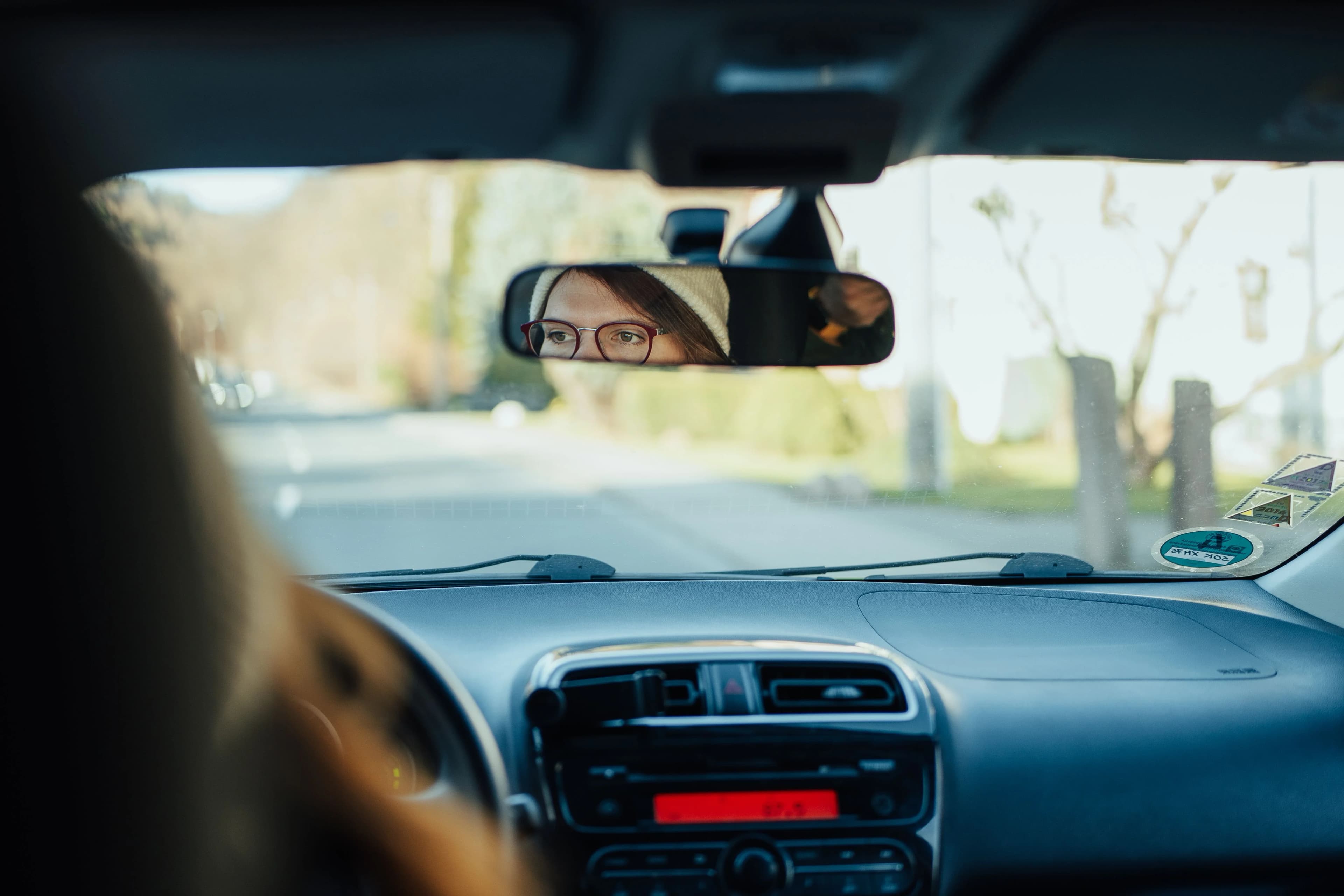
A correct mirror setting shrinks the blind spot and makes your shoulder check easier. Do it before you set off, in peace. Adjust your interior mirror so that you can see the whole rear window without turning your head. Point your exterior mirrors so that you can only just see a bit of your own car, but mainly the road beside and behind you. Many drivers angle their exterior mirrors too far inwards, so that they mostly see their own car and little traffic. Also check that your mirrors are clean: a misted-up or dirty mirror makes everything harder.
When do you check it?
Every time you move sideways. That means when pulling away from the kerb or a parking space, when changing lanes, when merging, when overtaking and returning to your lane, and when turning. Turning right in particular deserves extra attention, because cyclists and moped riders can be riding beside you without you noticing.
The right order
A fixed order makes sure you don't forget anything. First you look in your interior mirror, then in the exterior mirror on the side you want to move towards. You signal, so others know what you intend to do. Then comes a short glance over your shoulder, on the same side. And only then do you decide: if it's safe, you make the move, otherwise you wait.
The shoulder check is deliberately brief. You don't want to look away from the road ahead for too long. A quick, purposeful turn of the head is enough.
Show that you're looking
In the test, it's not just that you look that counts, but also that the examiner can see it. A visible head movement is therefore no superfluous luxury. If you only look in the mirror with your eyes, you quickly give the impression of not having checked, even if you did.
Where it often goes wrong
The most common mistake is skipping the shoulder check altogether and relying solely on the mirrors. You also see candidates who check too late, only when they're already starting to steer, and candidates who only do the check when pulling away and forget it when changing lanes or turning. Others look over their shoulder for so long that they drive a few metres blind. A short glance is enough.
Cyclists are also often underestimated. They're easy to overlook and can be faster than you think, especially with electric assistance.
Practising without pressure
Go to a quiet car park with your supervisor and have him or her walk or cycle around your car. You'll see for yourself how quickly someone disappears into your blind spot, and that insight sticks. Then practise the sequence on a quiet road: mirror, signal, shoulder, decide. It helps to say out loud what you're doing at every sideways movement ("mirror left, signal, shoulder, clear"). It feels strange at first, but it keeps you disciplined and lets your supervisor hear whether you're doing the steps in the right order.
A habit for life
Vehicles with a bigger blind spot
The blind spot of a passenger car is considerable, but that of a lorry or bus is much bigger, including on the right-hand side and right in front of and behind the vehicle. If you're cycling or driving a car next to such a vehicle, you may therefore be completely out of sight. The practical lesson: don't linger beside large vehicles, and at a junction choose a position where the driver can see you, or wait until he has moved off.
From your own car, this means being extra careful when you overtake a large vehicle. Do it in one smooth movement and don't stay in its blind spot.
Motorcycles and bicycles: narrow and fast
Motorcycles are narrow and can approach quickly. They disappear easily into your blind spot, and if you look in your mirror, you sometimes see only a single headlight in the distance that suddenly turns out to be close. That's why the shoulder check is so important when changing lanes. The same applies to cyclists and moped riders who ride between stationary cars and suddenly appear next to you when you pull away or turn. If you know that this kind of road user exists and is easy to miss, you automatically look better.
A short exercise with your supervisor
Stop your car in a quiet car park and ask your supervisor to stand in different places beside the car: level with your rear door, a bit further back, a bit further forward. Look in your mirrors each time and note when you see him and when you don't. Then turn your head over your shoulder and look at what you can see now.
You'll notice that there are places where someone isn't visible in any mirror. That insight sticks far better than any explanation.
Mirror setting and seating position
A better setting can noticeably shrink your blind spot. Sit upright, with your back against the backrest, and set your mirrors from that position. If you change your seating position later, you unconsciously also change what you see in your mirrors. So check your setting again after a long drive or a break.
Cameras and sensors are no replacement
Some cars have blind spot detection or cameras. They're a handy aid, but you can't rely on them blindly, and in the test you have to show that you observe for yourself. Use them as a supplement, not as a replacement for your shoulder check.
The shoulder check isn't an exam trick. It stays useful long after the test is behind you, and if you learn it now, you'll drive more safely later too. It costs you a second. That's little compared with what's at stake if you miss a cyclist or motorcyclist.